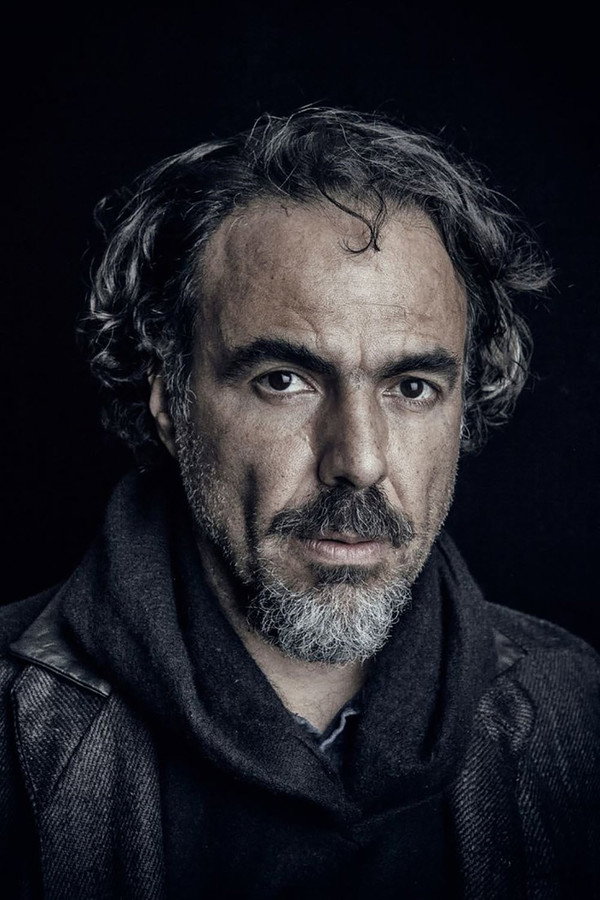
Alejandro González Iñárritu entered the film industry late and through the back door of advertising and radio waves. In the mid-1980s he was a star announcer at the Mexican radio station WFM 96.9, where he composed jingles for commercials and arranged music charts with obsessive precision. That ear, honed among vinyl records and commercial audio cuts, shaped how he approached film editing long before he ever touched a 35-millimeter camera.
In 1995 he directed the TV medium-length film Detrás del dinero, with singer Miguel Bosé as the marquee draw. It was a modest experiment, but it taught him that his ambitions required a far more brutal narrative rhythm than the usual small-screen formulas.
The Dog's Fracture and the Choral Pain
The premiere of Amores Perros at Cannes Critics' Week in 2000 shook up the conventions of Latin American cinema at the turn of the century. Iñárritu built a three-part structure held together by a car crash at the intersection of Juan Escutia and Atlixco avenues, supported by Guillermo Arriaga's sharp prose. The film grossed more than twenty million dollars worldwide on a budget of just two million.
Society was blown apart.
La alianza con Arriaga se extendió a producciones en lengua inglesa como 21 Grams en 2003 y culminó con Babel en 2006, rodada en cuatro países y tres continentes. Pero la pugna por la autoría intelectual terminó de reventar la relación entre ambos durante la campaña de premios en Cannes, donde el escritor exigió figurar en igualdad de condiciones en la autoría de la obra. Iñárritu cortó lazos, le vetó el acceso a varios actos públicos y el tándem se disolvió para siempre en los tribunales de la opinión pública.
For 2010, the director settled in Catalonia to shoot Biutiful, a bleak story about labor exploitation and marginalization in the outskirts of Barcelona, starring Javier Bardem. Filming consumed months of grueling work, and Bardem ended up scoring an Oscar nomination for Best Actor. Because physical demands were already a non-negotiable signature of his sets, the industry began to see him as a relentless auteur who made no technical compromises with anyone.
The Tyranny of the Long Take and the Frozen Mud
His leap into acid comedy came in 2014 with Birdman or (The Unexpected Virtue of Ignorance), after several years of quiet development. The project seemed like commercial suicide, built as a fake, uninterrupted long take inside the bowels of Broadway's St. James Theatre, with Michael Keaton as the decadent lead. Emmanuel Lubezki had to choreograph every camera movement with near-surgical precision to keep the illusion of visual continuity intact. The gamble was outrageous.
And the gamble paid off.
The film took home four Academy Awards, including Best Director and Best Picture. Rather than settle into an executive office, Iñárritu headed to the Canadian tundra and the far reaches of Tierra del Fuego to shoot The Revenant, released in 2015. He wanted to capture the agony of a 19th-century trapper without relying on artificial lighting or green screens.
Filming was a brutal logistical battle: the crew could only shoot for ninety minutes a day, taking advantage of real sunlight in sub-zero temperatures. There were mass layoffs, union complaints over the extreme cold, and a budget overrun that pushed the final bill up to $135 million. Leonardo DiCaprio ate raw meat on camera, and the box office responded with more than $530 million in worldwide ticket sales. That achievement earned Iñárritu his second consecutive Oscar for Best Director in 2016, a double no one had pulled off in Hollywood since 1950.
Settling Scores and an Industry Misstep
In 2017 he presented Carne y arena at the Cannes Film Festival, a virtual reality installation about the migration crisis that earned him a special Oscar from the Academy of Motion Picture Arts and Sciences. Five years later, he released Bardo, falsa crónica de unas cuantas verdades in 2022, financed by Netflix. This dreamlike, semi-autobiographical journey ran more than three hours at its press screening in Venice, where the chilly reception led the filmmaker to lock himself in the editing room and cut twenty-two minutes before it reached theaters.
So it was time to return to the big studio machinery.
For the shoot of Digger, developed between November 2024 and May 2025 on locations in the United Kingdom, he recruited Tom Cruise for an ecological satire of enormous scale. The film hit theaters in October 2026, shot on 65-millimeter film using the VistaVision system. The production budget reached $***180 million before marketing, while global box office earnings during its first four weeks did not exceed $47 million.