The Man Who Arrived Late to the Movies
Charles Coburn didn't step onto a professional film set until he was past sixty. Before that, he spent four decades touring stages across much of the United States with his own theater company. He wasn't chasing movie fame, because the stage was his natural habitat.
The industry called on him late.
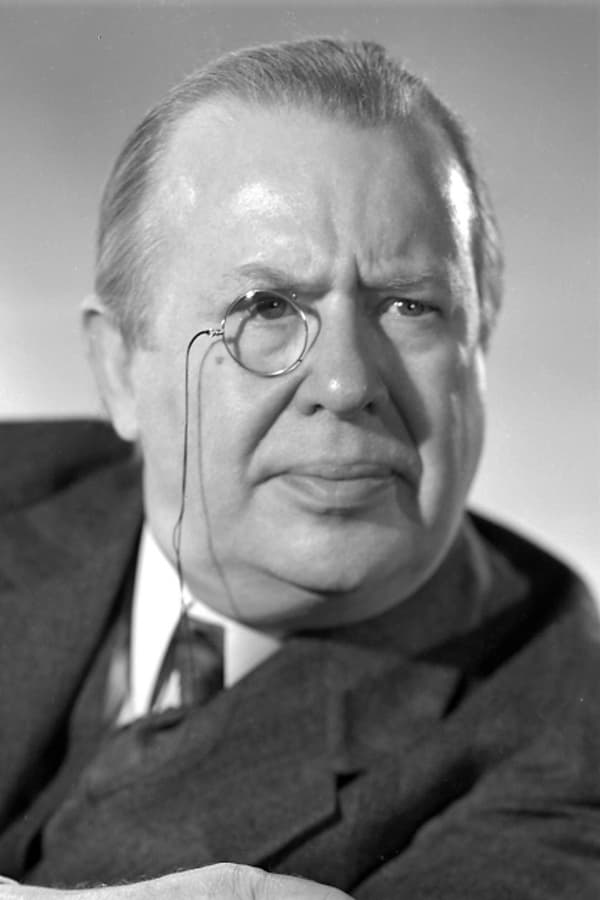
In 1937 he made his debut in Of Human Hearts, and Hollywood discovered that this older gentleman from Georgia had a magnetism that couldn't be bought with acting classes. His image with a monocle quickly became a trademark. But behind that accessory was an actor who controlled the rhythm of comedy with mathematical precision.
Coburn didn't need grand gestures to dominate the frame. His technique relied on economy of movement and a deep voice that commanded respect, even when he played somewhat ridiculous characters or smooth-talking swindlers.
The Supporting Actor Who Stole Scenes
In The Lady Eve, shot in 1941, he played opposite Barbara Stanwyck with stunning ease. He played the heroine's father, and he made a con artist come across as lovable to the average moviegoer. Studios soon began fighting over him to lend weight to their more ambitious comedies.
He won the Academy Award for Best Supporting Actor in 1943 for his role in The More the Merrier. That George Stevens film placed him at the top of character actors. He did it playing a retiree who rents part of his apartment during the Washington housing crisis of the war.
Coburn understood that humor doesn't come from the direct joke but from the awkward situation. His characters were often figures of authority, rich uncles or businessmen who hid a soft heart beneath layers of cynicism and pragmatism.
There was never a shortage of work.
Throughout the 1950s, he kept taking on projects nonstop despite his advanced age. In 1953 he appeared in Gentlemen Prefer Blondes alongside Marilyn Monroe and Jane Russell. He played Sir Francis Beekman, and his interaction with Monroe produced moments of very subtle physical comedy.
Monocles and Studio Contracts
He shot Monkey Business in 1952 under the direction of Howard Hawks. In that film he shared the bill with Cary Grant and Ginger Rogers. He accepted almost any script that would let him keep up with his lifestyle and his standing in New York's most exclusive clubs.
But his health began to falter toward the end of that decade. Despite his physical problems, he never officially retired from acting. He maintained that an actor only stops working when the audience stops watching, something that, in his case, never happened.
His last big-screen appearance came in 1961 in the film Pepe. A few months after wrapping that shoot, he died in New York from complications following throat surgery. He was 84 years old and left behind a filmography of more than sixty titles, made over just two decades in film.
The surgical procedure was performed at Lenox Hill Hospital on August 30, 1961.